
TL;DR:
- Using existing transaction data allows e-commerce businesses to make faster, more accurate decisions without additional data collection.
- It reveals real customer behavior patterns, improves insight speed, and reduces costs and risks associated with primary data gathering.
Leveraging existing data is the practice of using already collected transaction and customer records to power smarter business decisions without starting from scratch. For e-commerce business analysts and decision-makers, this approach is the fastest path to reducing uncertainty, cutting research costs, and generating customer insights that actually move revenue. Salesforce emphasizes combining quantitative and qualitative data to forecast growth patterns. The industry term for this practice is secondary data utilization, and it sits at the core of every serious data-driven decision making framework today.
Why leverage existing data instead of collecting new data?
The most direct answer: your transaction history already contains the answers to most of your growth questions. Collecting new primary data takes time, money, and specialized skills. Secondary data avoids the labor of recruiting participants, designing instruments, and waiting for results. That time savings alone gives e-commerce teams a measurable competitive edge when market conditions shift fast.
The benefits of using existing data go well beyond speed. Historical transaction records reveal purchase patterns, seasonal demand cycles, and customer lifetime value signals that no survey can replicate. These patterns are grounded in real behavior, not stated preferences. That distinction matters enormously when you are forecasting demand or building product bundles.
The core advantages of using existing transaction data include:
- Cost reduction. No new data collection budget required. Your Shopify, WooCommerce, or Stripe order exports are already paid for.
- Faster time to insight. Analysis can begin immediately rather than waiting weeks for primary data collection to close.
- Higher decision accuracy. Historical data reflects actual customer behavior, reducing the gap between assumption and reality.
- AI training efficiency. Well-organized existing data reduces noise in AI model training, improving learning speed and output accuracy.
- Risk reduction. Decisions grounded in real transaction history carry less uncertainty than those built on projections alone.
Pro Tip: Filter your existing data before analysis. Raw transaction exports from platforms like BigCommerce or Stripe often include test orders, refunds, and duplicate entries. Clean data produces segments that reflect true customer behavior, not system artifacts.
How can e-commerce teams unify scattered transaction data?
Scattered data is the most common reason businesses fail to extract value from records they already own. CRMs, payment processors, and storefront platforms each store customer signals in separate systems. Dell’s AI Data Platform addresses this by unifying billions of customer signals to enable instant next-best actions. The lesson for e-commerce teams is direct: integration precedes insight.

The goal is a single source of truth. Databricks achieves this by integrating Stripe payment data into a unified catalog via Databricks Marketplace, eliminating data duplication and enabling live queries with row-level security and audit trails. That architecture reduces costs and makes governance practical rather than theoretical.
| Integration approach | Key benefit | Main limitation |
|---|---|---|
| CSV export and upload | No engineering required, works with any platform | Manual process, not real-time |
| API connection | Live data access, automated refresh | Requires developer resources |
| Unified data catalog (e.g., Databricks Unity Catalog) | Single source of truth, governed access | Higher setup complexity |
| Direct warehouse query | Freshest data, no duplication risk | Needs data engineering expertise |
Pro Tip: Avoid copying transaction data into a separate storage layer just for analytics. Querying existing systems at inference time through governed sharing prevents data drift and keeps your customer segments current.
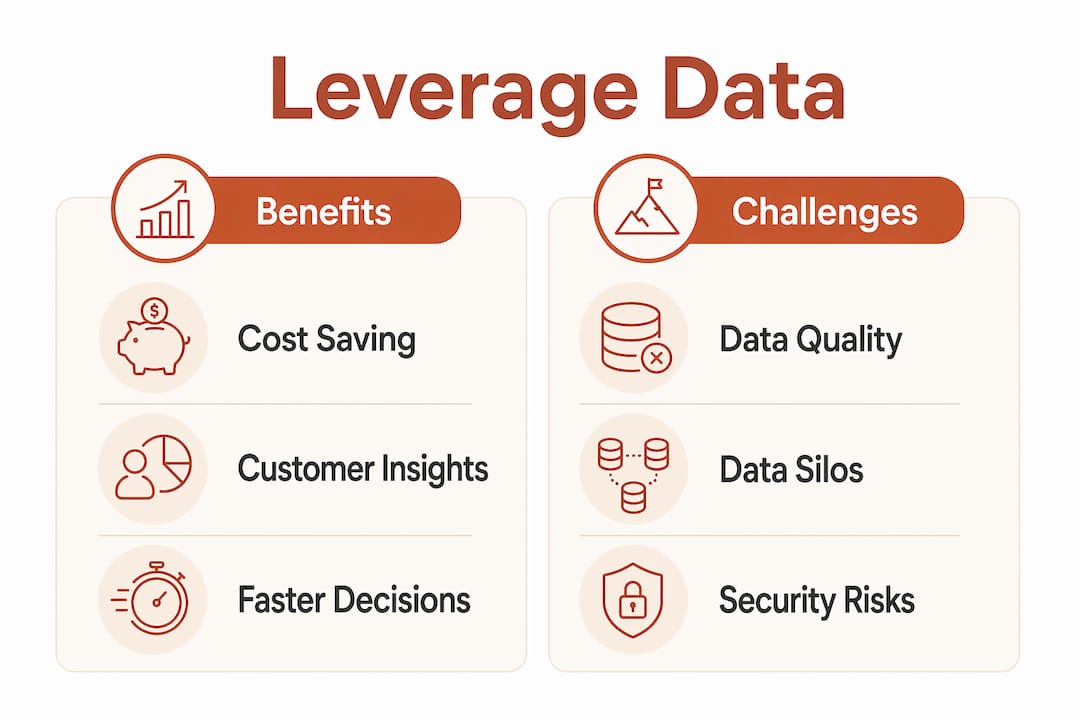
Governance is not optional. Security features like row-level access control and audit trails protect customer data while keeping it accessible to the analysts who need it. Without governance, data unification creates new compliance risks rather than solving old operational ones.
What analytics types apply to existing transaction data?
Coursera’s data-driven decision making framework defines four analytics types, each tied to a different decision stage. Matching the right analytics type to the right question is what separates reporting from actual decision support.
- Descriptive analytics answers “what happened.” Average order value by month, top-selling SKUs by region, and repeat purchase rates all fall here. This is the starting point for any transaction data analysis.
- Diagnostic analytics answers “why did it happen.” Cohort analysis showing that customers acquired through email convert at twice the rate of paid social customers is a diagnostic finding. It explains a pattern rather than just measuring it.
- Predictive analytics answers “what will happen.” Churn probability scores built from RFM (Recency, Frequency, Monetary) segmentation predict which customers are likely to lapse before they actually do.
- Prescriptive analytics answers “what should we do.” A next-best-offer engine that recommends a specific product bundle to a specific customer segment at a specific time is prescriptive. This is where existing data becomes a decision engine rather than a reporting asset.
The progression matters. Most e-commerce teams stop at descriptive analytics because their data is not unified or clean enough to support the higher tiers. Fixing the data foundation unlocks the full value chain. Explore AI applications for e-commerce to see how each analytics tier applies in real retail contexts.
What challenges arise when using existing transaction data?
The biggest technical trap is the dual version of truth problem. When analysts copy transaction data into a separate environment for reporting, that copy immediately begins to diverge from the live system. Governed data sharing rather than copying solves this. Two teams working from different data snapshots will reach different conclusions, and neither will be right.
Transaction data lifecycle complexity is a second major challenge. Accurate analytics requires modeling authorization events, captures, refunds, reversals, and descriptor corrections as separate lifecycle stages. A refunded order counted as revenue will inflate customer value scores and produce misleading segments.
Common pitfalls and their solutions:
- Data silos. Separate CRM, payment, and storefront systems produce incomplete customer profiles. Solution: unify via API or a shared catalog before running segmentation.
- Stale snapshots. Copied datasets drift from live systems within hours. Solution: query source systems directly or use governed real-time feeds.
- Unstable time windows. RFM segmentation validity depends on consistent time window definitions. Changing the lookback period mid-analysis produces segments that reflect methodology changes, not customer behavior changes.
- Dirty data. Test orders, internal purchases, and duplicate records skew every metric. Solution: define and apply cleaning rules before any analysis begins.
- Missing lifecycle events. Refunds and reversals not modeled separately inflate revenue and distort customer value calculations. Solution: treat each transaction event type as a distinct record in your data model.
How does using existing data drive strategic e-commerce growth?
The highest-value applications of existing transaction data are customer segmentation, churn prediction, and product association analysis. Transaction data analysis for e-commerce growth shows how order history alone can reveal which products are bought together, which customers are at risk of lapsing, and which segments respond to which offers.
RFM segmentation is the clearest example. By scoring customers on how recently they purchased, how often they buy, and how much they spend, you can identify your top 20% of customers by revenue contribution and target them with retention campaigns before they churn. This requires no new data collection. It requires only that your existing order data is clean, unified, and analyzed with a consistent methodology.
Product association analysis, also called market basket analysis, finds which products are purchased together at rates above chance. A sporting goods retailer with three years of transaction history can identify that customers who buy trail running shoes also buy hydration vests within 30 days at a rate that justifies a dedicated bundle offer. That insight lives in the existing data. It just needs to be extracted.
AI in e-commerce platforms now apply machine learning directly to transaction histories to surface these patterns at scale, without requiring a data science team. The competitive advantage goes to the businesses that act on these patterns first.
Pro Tip: Align your data analysis goals with a specific business question before you begin. “Understand our customers better” produces nothing. “Identify the top 10% of customers by lifetime value and their most common second purchase” produces a campaign.
Key Takeaways
Existing transaction data is the most cost-effective and behavior-accurate foundation for e-commerce decision-making, and the businesses that unify and analyze it systematically outperform those that do not.
| Point | Details |
|---|---|
| Secondary data saves time and money | Reusing transaction records eliminates primary data collection costs and speeds up analysis. |
| Unification precedes insight | Siloed CRM, payment, and storefront data must be unified before meaningful analysis is possible. |
| Analytics type must match decision stage | Descriptive, diagnostic, predictive, and prescriptive analytics each serve a different business question. |
| Data quality determines segment accuracy | Unstable time windows, refunds, and dirty records produce misleading customer segments. |
| Existing data powers growth use cases | RFM segmentation, churn prediction, and market basket analysis all run on data you already own. |
The real gap is not data volume, it is data discipline
Most e-commerce businesses I have seen are not data-poor. They are data-disorganized. A mid-size Shopify brand with three years of order history has more than enough raw material to build accurate customer segments, identify high-value cohorts, and run product association analysis. The problem is that the data sits in three systems, has never been cleaned, and gets exported manually once a quarter when someone needs a report.
The businesses that win with existing data are not the ones with the most records. They are the ones that treat data governance as an operational habit rather than a one-time project. That means defining cleaning rules and sticking to them, using consistent time windows for segmentation, and querying live systems rather than working from stale copies.
The other mistake I see constantly is chasing new tools before fixing the data foundation. A predictive analytics platform running on dirty, siloed transaction data will produce confident-looking outputs that are simply wrong. Fix the foundation first. The tools become dramatically more powerful when the data feeding them is unified, clean, and governed.
My honest recommendation: start with your existing order export from whatever platform you use, apply a consistent cleaning methodology, and run RFM segmentation before investing in anything else. The results will tell you exactly where to focus next.
— Mateusz
How Affinsy puts your existing transaction data to work
Affinsy is built specifically for e-commerce teams that want to extract growth insights from transaction data they already own, without needing a data science team to do it. The platform accepts order exports from Shopify, WooCommerce, BigCommerce, Stripe, and any other system that produces transactional data, via CSV upload or API. Affinsy then runs market basket analysis and RFM customer segmentation to surface product associations, identify high-value customer cohorts, and flag churn risk. The permanent free tier covers up to 20,000 line items with full product access and no credit card required. Paid plans start at $49 per month for larger datasets and API access.
FAQ
What does it mean to leverage existing data?
Leveraging existing data means using previously collected transaction and customer records to generate business insights without new primary data collection. The industry term is secondary data utilization, and it covers everything from RFM segmentation to product association analysis.
Why is historical transaction data valuable for e-commerce decisions?
Historical transaction data reflects actual customer behavior rather than stated preferences, making it more accurate for forecasting, segmentation, and churn prediction. It also requires no additional collection cost, since the data already exists in your order management or payment system.
What is the biggest risk when using existing transaction data?
The biggest risk is working from stale or dirty data. Copied datasets drift from live systems, and uncleaned records that include refunds, test orders, or duplicates produce misleading customer segments and revenue figures.
How do I start using my existing data for customer segmentation?
Export your order history from your current platform, apply cleaning rules to remove refunds and test orders, define a consistent lookback window, and run RFM scoring. Tools like Affinsy automate this process directly from a CSV upload.
What analytics types can I apply to existing transaction data?
Descriptive analytics shows what happened, diagnostic analytics explains why, predictive analytics forecasts future behavior, and prescriptive analytics recommends specific actions. Each tier requires cleaner and more unified data than the one before it.
Recommended
- Data Driven Ecommerce: Unlocking Revenue Potential - Affinsy Blog | Affinsy
- Guide to E-Commerce Data Analysis for Increased Sales - Affinsy Blog | Affinsy
- Data-Driven Ecommerce Strategies for Smarter Growth - Affinsy Blog | Affinsy
- Sales Data Insights: Powering E-Commerce Growth - Affinsy Blog | Affinsy