
TL;DR:
- Market basket analysis helps retailers identify products frequently bought together, leading to increased sales.
- Using MBA with proper filtering and segmentation can boost revenue by 20 to 25 percent through better product placement and bundling.
Market basket analysis (MBA) is a data mining technique that identifies which products customers buy together, giving retail executives a direct path to higher sales, smarter layouts, and better inventory decisions. The term “MBA” in retail refers to this analytical method, not a business degree. Retailers leveraging MBA report 20–25% increases in sales across apparel and e-commerce sectors. That number reflects what happens when product placement and cross-selling stop being guesswork and start being grounded in actual purchase behavior. Affinsy applies this exact methodology to help retail and e-commerce teams act on their transaction data without needing a data science team.
Why use MBA in retail: the core case
MBA works by scanning thousands of transactions to find products that appear together more often than chance would predict. The output is a set of association rules: “customers who buy X also buy Y.” Those rules become the foundation for every cross-sell recommendation, bundle offer, and planogram decision a retailer makes.
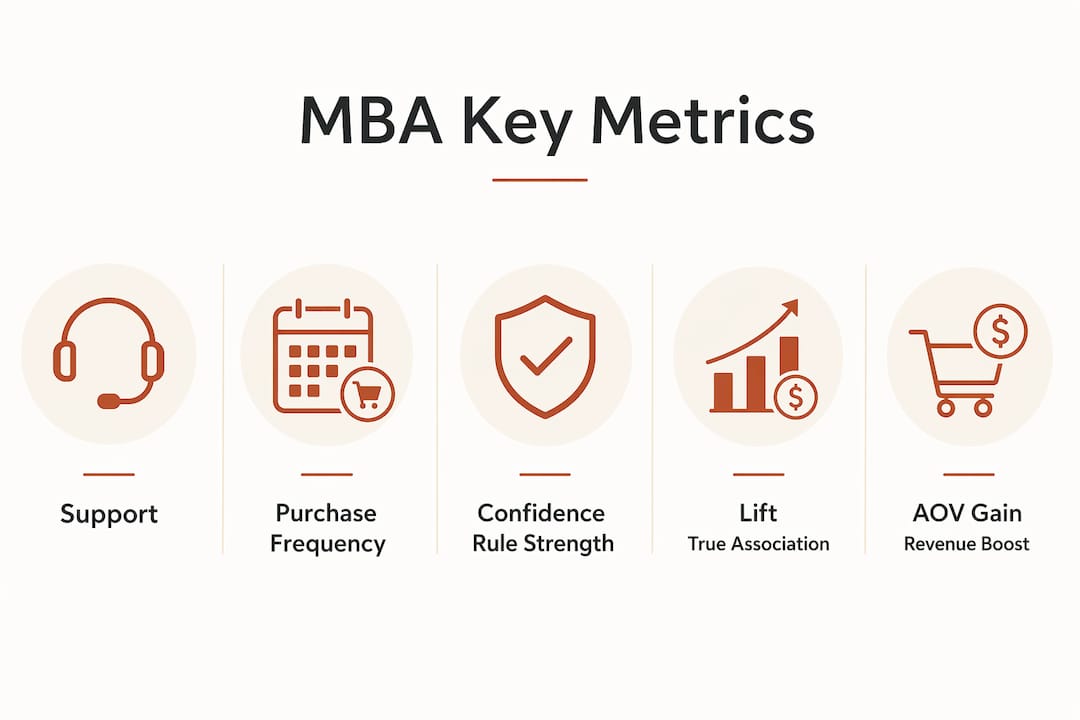
Three metrics govern every association rule. Support, confidence, and lift are the numbers that separate a meaningful pattern from a coincidence. Support measures how often a product pair appears across all transactions. Confidence measures how often Y appears when X is in the cart. Lift measures whether the two products appear together more than their individual popularity would predict.
Lift is the metric most executives underuse. A camera and a memory card might both sell well independently, giving them high confidence as a pair. But if lift is close to 1.0, the association is weak. Filtering by lift prevents wasting promotional dollars on product pairs that just happen to be popular rather than genuinely linked in customer behavior.
Machine learning integration has made MBA more accurate. Modern platforms layer collaborative filtering and sequence modeling on top of classic association rules, catching patterns that static rule mining misses. The result is a system that improves as transaction volume grows.
Pro Tip: Set a minimum lift threshold of 1.5 before acting on any association rule. Rules below that threshold rarely produce meaningful lift in revenue when promoted.
What measurable benefits does MBA deliver for retail businesses?
The sales impact of MBA is well documented. Retailers in apparel and e-commerce who deploy MBA report sales gains of 20–25%. That gain comes from three compounding effects: higher average order value (AOV), better product discovery, and reduced stockout friction.
Cross-selling based on real purchase history maximizes customer lifetime value and removes the guesswork that kills margin. Effective bundles come from what customers actually buy together, not from what merchandisers assume they want.
AOV gains are the most immediate benefit. When a shopper adding a yoga mat to their cart sees a prompt for a foam roller because 38% of yoga mat buyers also bought one, the incremental revenue requires no additional acquisition cost. Data-driven bundling built from real purchase history consistently outperforms bundles assembled by intuition.
MBA also improves inventory planning. When you know that product A and product B sell together at a high rate, you can align replenishment cycles, avoid stocking one without the other, and reduce the revenue loss that comes from breaking a natural pair. Workforce planning benefits too. High-traffic product clusters inform where to station staff and how to sequence restocking runs.
Rising customer acquisition costs make lifetime value the metric that matters most. Purchase-based bundles built from MBA data increase repeat purchase rates because they reflect what customers already want, not what the business hopes they will buy.
How can retail executives apply MBA insights to merchandising and marketing?
Store layout is the highest-leverage application of MBA for physical retailers. Data-driven product placement reduces shopper friction and raises AOV by positioning frequently co-purchased items near each other. Moving from intuition-based planograms to evidence-based ones is one of the fastest ways to see MBA pay off in a brick-and-mortar environment.

For e-commerce, the equivalent is the recommendation engine. MBA outputs feed directly into “frequently bought together” modules, post-purchase upsell pages, and cart abandonment emails. Each touchpoint becomes more relevant because it reflects actual purchase sequences rather than editorial guesses.
Four practical steps for applying MBA in merchandising and marketing:
- Run association rules on the last 12 months of transactions. Seasonal patterns matter, so a full year of data captures holiday behavior, back-to-school cycles, and off-peak periods without distorting the rules.
- Segment before you model. Associations differ by customer type. Loyal customers and price-sensitive shoppers exhibit distinct purchase patterns. Running MBA on a blended dataset produces rules that fit no one well.
- Build bundles from the top 20 high-lift pairs. Price the bundle at a 5–10% discount to the sum of individual prices. Track AOV and attach rate weekly for the first month.
- Use purchase sequencing for post-purchase campaigns. If customers who buy a coffee maker typically buy a grinder within 30 days, trigger an email on day 14. Timing the offer to the natural purchase window increases conversion without discounting.
Pro Tip: Run separate MBA models for your top three customer segments before building any bundle. A rule that looks strong in aggregate often disappears or reverses when you look at high-value customers alone.
What are advanced analytical approaches that enhance traditional MBA?
Static association rules capture what customers buy together but miss the dimension of time. Combining association mining with temporal trend analysis adds a forecasting layer that tells you not just what goes together, but when the second purchase is most likely to happen. A study validating this multi-dimensional framework used 30,000 transactions and found that integrating time-series forecasting with MBA improved demand planning accuracy meaningfully.
Network analysis is a second enhancement worth adopting. Treating products as nodes and co-purchase frequency as edge weights reveals product clusters that simple pairwise rules miss. A product sitting at the center of a dense cluster is a natural anchor for a bundle or a promotional display. One sitting at the periphery may be a candidate for discontinuation or repositioning.
AI-driven personalization layered on MBA outputs takes the analysis further. Retailers consistently underestimate the predictive power sitting in their existing transaction data. Adding a personalization layer means the system learns individual customer trajectories, not just population-level patterns.
| Analytical approach | What it adds | Best use case |
|---|---|---|
| Classic association rules | Product co-purchase patterns | Bundle design, planograms |
| Temporal sequence analysis | Timing of follow-on purchases | Post-purchase email triggers |
| Network analysis | Product cluster mapping | Assortment planning, discontinuation |
| AI personalization layer | Individual-level predictions | Real-time recommendations |
Segmenting transaction data before running any of these models is non-negotiable. Different customer groups produce distinct association patterns. A model trained on all customers at once will average out the signal that makes each segment valuable. Segment first, then model each group separately, then compare the rules to find both shared patterns and segment-specific opportunities.
Key Takeaways
Market basket analysis is the most direct path from transaction data to higher revenue, and retailers who segment their data before modeling extract the strongest, most actionable signals.
| Point | Details |
|---|---|
| Lift is the critical filter | Always filter association rules by lift above 1.5 to avoid promoting coincidental product pairs. |
| Sales impact is proven | Retailers using MBA report 20–25% sales gains in apparel and e-commerce deployments. |
| Segment before modeling | Run separate MBA models per customer segment to avoid rules that fit no group well. |
| Time adds predictive power | Combining association rules with temporal analysis improves demand planning and email timing. |
| Bundles beat intuition | Bundles built from real purchase history consistently outperform editorially assembled ones. |
MBA in retail is maturing faster than most executives realize
I have watched retail analytics teams spend months building dashboards that show what happened last quarter while their transaction data sits untouched. MBA is not a new technique. The Apriori algorithm has been around since the 1990s. What has changed is the accessibility of the tooling and the volume of transaction data available to mid-market retailers.
The mistake I see most often is treating MBA as a one-time project. A team runs the analysis, builds a few bundles, sees a short-term AOV bump, and moves on. The real value comes from running MBA continuously, segmenting by customer cohort, and feeding the outputs into live recommendation systems and email triggers. That is when the 20–25% sales figure becomes a floor rather than a ceiling.
The other common misstep is skipping the lift filter. Confidence alone will produce rules that look compelling but reflect nothing more than the fact that two products are both popular. I have seen promotional budgets wasted on “associations” that had lift scores below 1.1. Filtering by lift is not a technical detail. It is the difference between a promotion that pays for itself and one that does not.
The future of MBA in retail sits at the intersection of temporal analysis and AI personalization. The retailers who will win are those who treat their transaction history as a living asset, not a reporting archive. The step-by-step MBA process is not complicated. The discipline to run it consistently and act on the outputs is what separates the teams that see results from those that do not.
— Mateusz
How Affinsy puts MBA to work for retail teams
Affinsy is built for retail and e-commerce teams who want MBA insights without hiring a data science team. The platform analyzes your historical transaction data to surface high-lift product associations, segment your customers by purchase behavior, and generate the bundle and cross-sell recommendations your merchandising and marketing teams can act on immediately.
You can connect via CSV upload, API, or MCP. There is no complex integration required. Export your order data from Shopify, WooCommerce, BigCommerce, Stripe, or any system that produces transactional data, and Affinsy handles the analysis. The permanent free tier covers up to 20,000 line items with full product access and no credit card required. For a deeper look at how MBA works and what it can do for your product strategy, the MBA glossary page is a good place to start. Paid plans begin at $49/mo for larger datasets and API access.
FAQ
What does MBA stand for in retail?
MBA stands for market basket analysis, a data mining method that identifies products customers frequently buy together. It is not related to a business degree in this context.
How does MBA increase average order value?
MBA reveals high-lift product pairs that retailers can bundle or recommend at checkout. Data-driven bundles built from real purchase history consistently raise AOV without requiring discounts deep enough to hurt margin.
What is the difference between confidence and lift in MBA?
Confidence measures how often product Y appears when product X is purchased. Lift measures whether that co-occurrence is stronger than chance. High confidence with low lift means both products are simply popular, not genuinely associated.
How much data do you need to run MBA?
A minimum of several thousand transactions is needed to produce statistically reliable rules. More transactions and longer time windows produce more stable associations, especially for seasonal product categories.
Can MBA work for online retail as well as physical stores?
MBA applies equally to e-commerce and brick-and-mortar retail. Online retailers use it to power recommendation modules and email triggers, while physical stores use it to design planograms and product adjacencies.
Recommended
- Data-Driven Decision Making in Retail – Impact on Sales Growth - Affinsy Blog | Affinsy
- Segmentation + market basket analysis: 40% more revenue - Affinsy Blog | Affinsy
- Role of MBA in Ecommerce: Driving Sales and Retention - Affinsy Blog | Affinsy
- Understanding Retail Analytics Guide 2025 for E-Commerce Success - Affinsy Blog | Affinsy