
TL;DR:
- Historical transaction data records every purchase, return, and order event for e-commerce stores. It is essential for customer analysis, marketing strategies, and building accurate predictive models. Storing data at the line-item level ensures reliable insights and supports compliance with recordkeeping requirements.
Historical transaction data is the structured record of every purchase, return, and order event your store has ever processed. For e-commerce professionals and data analysts, it is the single most reliable input for understanding customer behavior, identifying product relationships, and building marketing strategies that actually work. Frameworks like market basket analysis (MBA) and RFM customer segmentation both depend entirely on this data. Without clean, granular transaction history, neither tool produces results worth acting on.
What is the role of historical transaction data in e-commerce analytics?
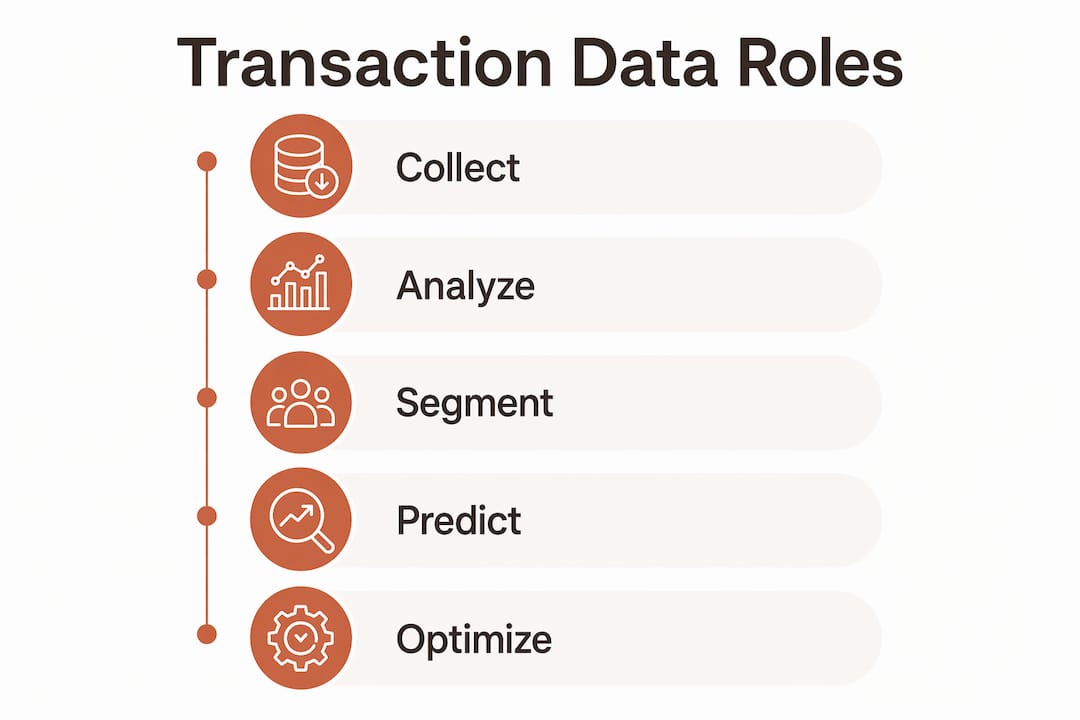
Historical transaction data is the foundation of every meaningful analytics output in e-commerce. It records what customers bought, when they bought it, how much they spent, and how often they return. That raw record is the input for transaction data analysis techniques ranging from simple cohort reports to advanced predictive models.

The importance of transaction history goes beyond reporting. It tells you which products are bought together, which customers are drifting away, and which segments generate the most lifetime value. Shopify Analytics, for example, surfaces these patterns directly from order records. The IRS also recognizes the operational value of transaction records, noting that complete records help businesses monitor progress, prepare financial statements, and support tax filings.
The impact of past transaction data compounds over time. A store with two years of order history can detect seasonal demand shifts, model churn risk, and forecast inventory needs with far greater accuracy than one working from a few months of data.
How market basket analysis uses transaction history to improve cross-selling
Market basket analysis identifies which products customers buy together by mining association rules from order records. Association rules are measured by three metrics: support (how often an itemset appears across all orders), confidence (the probability that buying product A leads to buying product B), and lift (how much more likely the co-purchase is compared to random chance). A lift value above 1.0 signals a genuine relationship worth acting on.
The practical output is direct. If your data shows that customers who buy a yoga mat also buy resistance bands with high confidence and lift, you bundle those products, create a cross-sell email, or surface the recommendation at checkout. That decision comes entirely from the pattern in your transaction history, not from intuition.
Association rule mining only works when your data is structured correctly. Correct basket construction requires one row per order line item, with order IDs and SKUs intact. If your export groups multiple items into a single cell or strips order IDs, the algorithm cannot reconstruct which products appeared in the same basket.
Pro Tip: Always define your transaction boundary before running MBA. An order boundary groups everything in one checkout. A session boundary groups browsing behavior. These produce very different association rules and very different marketing actions. Choose the boundary that matches your business question.
The table below shows how the three core MBA metrics differ in what they measure and how to interpret them:
| Metric | What it measures | Actionable threshold |
|---|---|---|
| Support | How often an itemset appears in all orders | Higher support means broader applicability |
| Confidence | Probability B is bought given A is bought | Above 0.5 is generally worth testing |
| Lift | Strength of association vs. random chance | Above 1.0 confirms a real relationship |
A step-by-step MBA example shows how these metrics translate into product bundling and email campaign decisions for real e-commerce catalogs.
How RFM segmentation turns purchase history into retention strategy
RFM segmentation is a transaction data analysis technique that scores every customer on three dimensions: Recency (how recently they bought), Frequency (how often they buy), and Monetary value (how much they spend). RFM requires no machine learning. It runs on a simple orders table with customer IDs, order dates, and revenue figures, making it one of the most accessible frameworks in e-commerce analytics.
The segmentation process produces named groups that map directly to marketing actions:
- Champions bought recently, buy often, and spend the most. Reward them with early access or loyalty perks.
- Loyal customers buy regularly but may not be your top spenders. Upsell and ask for reviews.
- At Risk customers used to buy frequently but have gone quiet. Target them with win-back campaigns before they churn permanently.
- Lost customers have not purchased in a long time and scored low on frequency. Re-engagement costs are high here. Prioritize other segments first.
- New customers bought once recently. Onboarding sequences and second-purchase incentives apply here.
The power of RFM is that it maps complex behavior into intuitive segments without requiring a data science team. A SQL query against your orders table is enough to score and rank your entire customer base.
Pro Tip: Recency is the strongest predictor of future purchase behavior in most e-commerce categories. If you can only act on one RFM dimension, prioritize recency scoring first.
A practical RFM segmentation guide for DTC brands shows how to apply this framework directly to Shopify order exports and build a retention playbook from the results.
Why transactional grain determines the quality of your analytics
Transactional grain refers to the level of detail at which each row in your data table is stored. The correct grain for e-commerce analytics is one row per order line item, meaning each product in each order gets its own record. Storing data at this grain lets you roll up to any level: order totals, customer totals, product totals, or category totals.
Wrong grain is the most common hidden risk in e-commerce data work. Pre-aggregated monthly totals, for example, destroy the order-level detail you need for MBA and RFM. Pre-aggregated records cannot tell you which products appeared in the same basket or how many times a specific customer ordered in a given month.
Returns and cancellations belong in your transaction data as first-class records, not as deletions or adjustments to existing rows. Modeling them separately preserves the original purchase record while giving you accurate net revenue and refund attribution for marketing analytics.
The comparison below shows what you can and cannot do with each storage approach:
| Data format | MBA possible | RFM accurate | Refund attribution |
|---|---|---|---|
| Line-item grain | Yes | Yes | Yes |
| Order-level grain | Partial | Yes | Partial |
| Monthly aggregates | No | No | No |
Best practice for ETL processes is to preserve the raw line-item export from Shopify, WooCommerce, BigCommerce, or Stripe before any transformation. Aggregate only at query time, never at storage time.
What advanced sequence models reveal that aggregates miss
Traditional analytics treats each customer as a single row of aggregated metrics: total orders, total spend, average order value. Sequence-aware models treat each customer as an ordered list of events, preserving the timing and context of every transaction. Sequential transformer models learn long-range dependencies across that event history, capturing patterns that a single-row aggregate cannot represent.
NVIDIA’s transaction foundation model approach demonstrates this clearly in fraud detection. A transformer trained on transaction sequences detects behavioral anomalies that only become visible when the full history is considered in order. The same principle applies to e-commerce marketing: a customer who bought winter gear in october, returned it in november, and bought again in december shows a behavioral pattern that an aggregate row would flatten into noise.
The practical benefits for e-commerce analysts include:
- Better churn prediction: sequence models detect declining engagement earlier than recency scores alone
- Smarter product recommendations: the model knows what the customer bought last, not just what they buy on average
- Fraud signal detection: unusual sequences stand out against a customer’s established behavioral baseline
Combining raw transaction features with sequence embeddings produces the strongest predictive results. Raw features provide interpretability; embeddings provide context.
“Sequential and self-attention models find meaningful behavioral signals in customer transaction histories that are inaccessible to traditional aggregations.” — NVIDIA Technical Blog
Predictive analytics in retail increasingly depends on this sequence-aware approach as transaction datasets grow larger and customer journeys grow more complex.
Why compliance and recordkeeping are part of your data strategy
Transaction records serve a legal and operational function beyond analytics. The IRS states that good records help businesses monitor their financial progress, prepare accurate financial statements, identify income sources, and support tax returns during an examination. For e-commerce brands, this means your order history is not just a marketing asset. It is a compliance requirement.
The operational benefits of complete transaction records include:
- Income tracking: every order ties to a revenue event that must be reported accurately
- Expense attribution: returns, refunds, and shipping costs are deductible and must be documented at the transaction level
- Audit readiness: complete, accurate records reduce examination time and support every line of your tax return
- Business performance monitoring: year-over-year order comparisons reveal growth trends that inform hiring, inventory, and marketing budget decisions
The same data that powers your RFM model also satisfies your accountant. Maintaining a single, clean, line-item transaction table serves both purposes without duplication.
Key takeaways
Historical transaction data drives every major e-commerce analytics output, from MBA and RFM segmentation to sequence-based predictive models, and its value depends entirely on storing it at the correct grain.
| Point | Details |
|---|---|
| MBA needs correct grain | Association rules require one row per order line item with order IDs and SKUs intact. |
| RFM needs no ML | Recency, frequency, and monetary scoring runs on a basic orders table with no model training. |
| Grain determines accuracy | Pre-aggregated data cannot support MBA, accurate RFM, or refund attribution. |
| Sequences beat aggregates | Transformer models trained on transaction sequences detect patterns that single-row summaries miss. |
| Records serve compliance | Line-item transaction history satisfies IRS recordkeeping requirements and supports audit defense. |
What I have learned from working with transaction data in the real world
The most common mistake I see e-commerce teams make is exporting their order data once, aggregating it for a report, and then discarding the raw file. That decision destroys months of analytical potential. The aggregate answers one question. The raw line-item file answers every question you have not thought of yet.
RFM is where I always start with a new client. It requires no special tools, runs in SQL or even a spreadsheet, and immediately surfaces the customers worth protecting. The At Risk segment almost always contains revenue that can be recovered with a single targeted email campaign. I have seen brands recover meaningful revenue simply by identifying customers who had not ordered in 90 days and sending them a personalized win-back offer built entirely from RFM scoring.
The shift toward sequence models is real, but most mid-sized e-commerce brands are not there yet. The prerequisite is clean, granular, well-labeled transaction history. Teams that invest in data quality now will be positioned to use these models when they become more accessible. Teams that skip the fundamentals will find that no amount of advanced modeling fixes a poorly structured dataset.
My honest advice: treat your transaction table as a permanent asset. Export it at the line-item level, store it with timestamps and order IDs, and never aggregate before you need to. Everything else in your analytics stack depends on that foundation.
— Mateusz
How Affinsy applies these frameworks to your transaction data
Affinsy is built specifically for e-commerce teams who want to run market basket analysis and RFM segmentation without building a data pipeline from scratch.
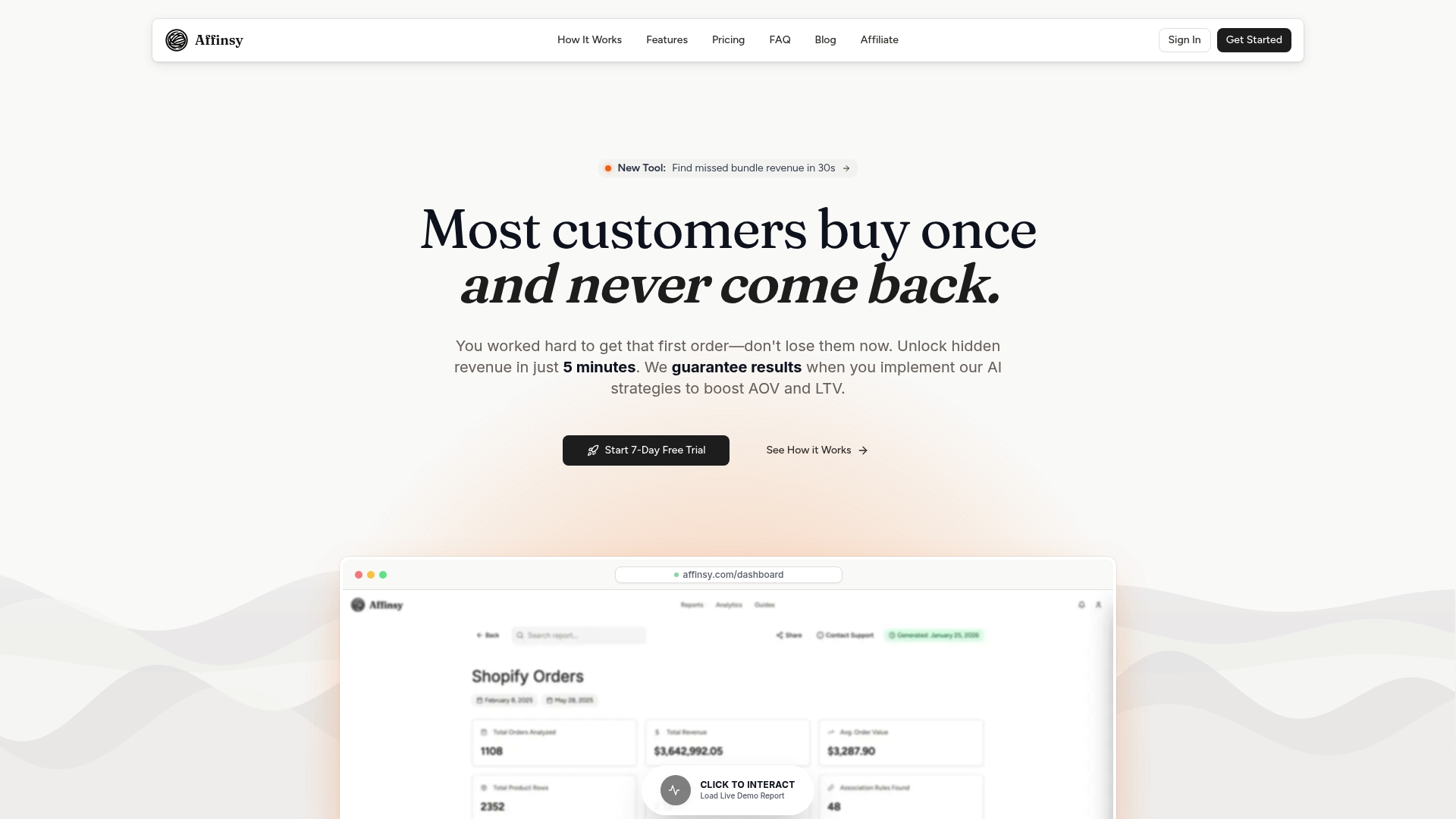
You export your order data from Shopify, WooCommerce, BigCommerce, Stripe, or any platform that produces transactional records, then upload it via CSV or connect through the API. Affinsy handles the analysis and surfaces product associations and customer segments you can act on immediately. The market basket analysis tools identify high-lift product pairs for bundling and cross-sell campaigns. The customer segmentation tools score your entire customer base on RFM dimensions and map them to retention-ready segments. A permanent free tier covers up to 20,000 line items with no credit card required.
FAQ
What is historical transaction data in e-commerce?
Historical transaction data is the complete record of every order, line item, return, and payment event processed by a store over time. It includes order IDs, customer IDs, SKUs, timestamps, and revenue figures at the line-item level.
How does transaction history improve marketing decisions?
Transaction history reveals which products are bought together, which customers are at risk of churning, and which segments generate the most revenue. These patterns directly inform cross-sell campaigns, retention offers, and budget allocation.
What is the correct grain for storing transaction data?
The correct grain is one row per order line item. This level of detail supports market basket analysis, accurate RFM scoring, and refund attribution without data loss.
Can small e-commerce stores benefit from RFM segmentation?
RFM segmentation requires no machine learning and runs on a basic orders table. Any store with a few hundred orders and customer IDs can score and segment its customer base using SQL or a spreadsheet.
How long should e-commerce businesses keep transaction records?
The IRS recommends keeping records as long as they may be needed to support reported income and expenses. For most e-commerce businesses, retaining at least three to seven years of transaction history covers both compliance requirements and long-term analytics needs.
Recommended
- Transaction data: boost sales, segment customers in 2026 - Affinsy Blog | Affinsy
- Sales Data Analysis: Unlocking E-Commerce Growth - Affinsy Blog | Affinsy
- Guide to E-Commerce Data Analysis for Increased Sales - Affinsy Blog | Affinsy
- Sales Data Insights: Powering E-Commerce Growth - Affinsy Blog | Affinsy