
TL;DR:
- Customer retention is crucial because it costs less and generates more profit than acquiring new customers. Improving retention by 5% can increase profits by up to 95% through increased repeat purchases and referrals. Retention depends on consistent, personalized experiences and diligent operational practices rather than solely loyalty programs.
Customer retention is the ability of a business to keep existing customers returning and spending over time. It is the single most direct lever for e-commerce profitability, and the numbers prove it: a 5% increase in retention can lift overall profits by 25% to 95%. Yet most e-commerce brands spend the majority of their marketing budget chasing new customers, while the revenue sitting in their existing base quietly walks out the door. Understanding why customer retention matters is not a philosophical exercise. It is a financial one.
Why customer retention matters for your bottom line
Retained customers cost less to serve, buy more often, and refer others. That combination creates a compounding effect on profit that no acquisition campaign can replicate at scale.

The cost advantage is stark. Acquiring a new customer costs between 5 and 25 times more than keeping an existing one. That gap means every dollar you redirect from acquisition toward retention stretches further and returns faster.
Repeat customers also spend more per transaction over time. They know your catalog, trust your brand, and are less sensitive to price. A customer who has bought from you three times is far less likely to abandon a cart over a $5 shipping fee than someone visiting for the first time.
Referrals compound the effect further. Up to 60% of loyal customers refer their favorite brands to close contacts. That referral traffic arrives pre-sold, with zero additional acquisition spend attached to it.
Pro Tip: Track referral revenue as a separate line item in your analytics. Most e-commerce brands undercount it, which causes them to undervalue retention investment.
The profit math behind a 5% retention gain
The Bain & Company research cited by Zendesk and Stripe puts the profit impact of a 5% retention improvement at 25% to 95%. That range is wide because it depends on your margin structure and average order value. But even at the low end, a 25% profit lift from a 5% behavioral shift is an extraordinary return. No paid channel delivers that ratio consistently.
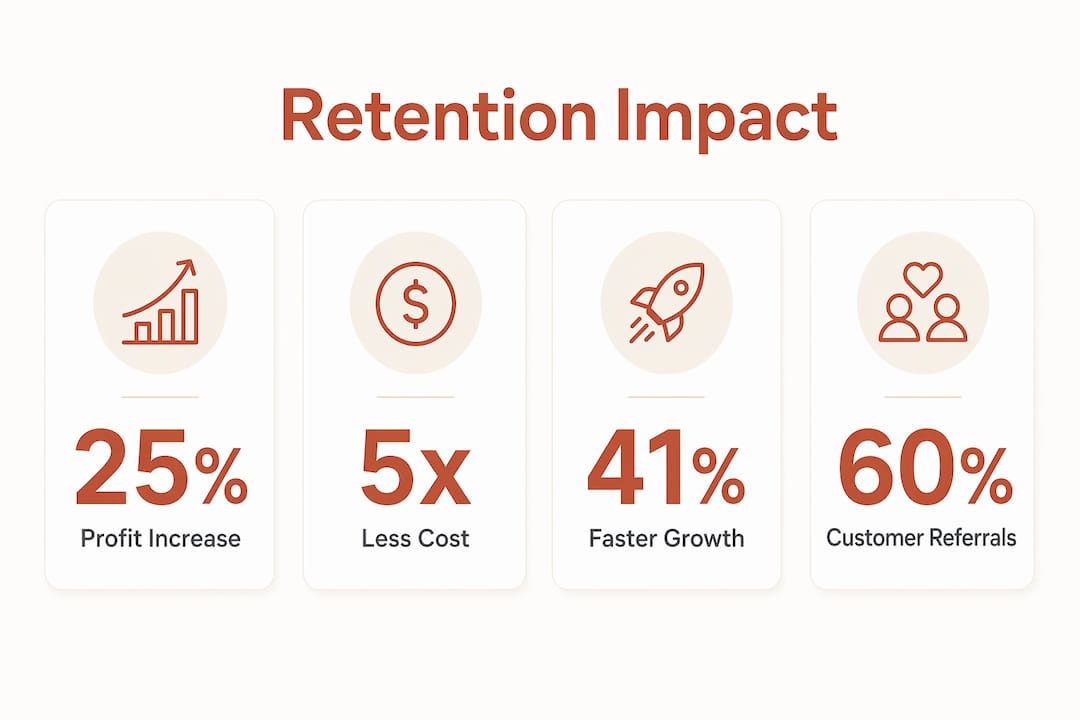
Customer-obsessed businesses grow revenue 41% faster and profit 49% faster than competitors who treat customers as transactions. The difference is not product quality or pricing. It is the discipline of building systems that keep customers engaged after the first purchase.
| Driver | Impact on profitability |
|---|---|
| Repeat purchase frequency | Higher revenue per customer without added acquisition cost |
| Lower service cost per customer | Familiar customers require less support time and fewer returns |
| Referral generation | New customers acquired at near-zero marginal cost |
| Reduced price sensitivity | Loyal customers accept premium pricing and fewer discounts |
Retention vs. acquisition: which one actually scales?
Acquisition and retention are not equal growth levers. Retention scales exponentially while acquisition scales linearly. That distinction changes how you should allocate budget as your business grows.
Acquisition works like a faucet. You spend more, you get more customers. But the moment you stop spending, the flow stops. Retention works like a reservoir. Each customer you keep adds to a base that generates revenue without requiring continuous spend to maintain it.
The “leaky bucket” problem describes what happens when brands rely entirely on acquisition. You pour customers in at the top, but they drain out the bottom through churn. The bucket never fills. Operational discipline in retention is the fix, and it is often overlooked in favor of more visible acquisition metrics.
| Factor | Acquisition focus | Retention focus |
|---|---|---|
| Cost per customer | 5–25x higher | Lower over time |
| Revenue predictability | Variable, spend-dependent | Stable, compounding |
| Referral generation | Minimal | High among loyal customers |
| Profit margin impact | Erodes with ad costs | Improves with repeat purchases |
| Scalability | Linear | Exponential |
The current economic environment makes this contrast sharper. Paid media costs on platforms like Meta and Google have risen significantly over the past three years. Brands that built strong retention systems before those cost increases now have a structural margin advantage over competitors still dependent on paid acquisition.
What actually drives retention in e-commerce?
Loyalty programs alone do not retain customers. 84% of loyalty program members are more likely to make repeat purchases, but without a strong underlying experience, those programs erode brand equity rather than build it. A discount code cannot compensate for a slow delivery, an unhelpful support agent, or a confusing returns process.
The factors that actually move retention rates fall into three categories:
- Consistency across touchpoints. 85% of CX leaders report that customers will leave after a single unresolved issue. One bad interaction undoes multiple good ones. Retention is won through reliable experiences across the entire customer lifecycle, not isolated great moments.
- Personalization backed by data. Generic email blasts and one-size-fits-all promotions do not retain customers. Personalization and behavioral analytics identify friction points and activate proactive interventions before a customer churns. Knowing that a customer segment buys every 45 days lets you reach them on day 40 with a relevant offer, not a random one.
- Post-purchase experience. The first experience after purchase, including onboarding, delivery, and first support interaction, critically affects churn and lifetime value. Brands that treat the post-purchase phase as an afterthought permanently cap the value of every customer they acquire.
Frameworks like the Three Rs (Rewards, Relevance, Recognition) and the 8 Cs (Consistency, Customization, Communication, Care, Community, Convenience, Commitment, and Credibility) give retention teams a structured way to audit their programs. The value of these frameworks is not in memorizing the labels. It is in using them to find the gaps in your current experience.
Pro Tip: Map your post-purchase customer journey from confirmation email through first reorder. Most e-commerce brands discover at least two friction points they were not aware of. Fix those before launching any new loyalty program.
For a deeper look at how behavioral data shapes retention, the patterns in your transaction history are often the clearest signal of where customers disengage.
How to measure retention and know if it is working
You cannot manage what you do not measure. The core metrics for e-commerce retention are customer retention rate, churn rate, and net revenue retention.
- Customer retention rate measures the percentage of customers who made at least one additional purchase within a defined period. Calculate it by dividing returning customers by total customers at the start of the period, then multiply by 100.
- Churn rate is the inverse. It tells you the percentage of customers who did not return. High churn in the first 90 days after acquisition signals a post-purchase experience problem, not a product problem.
- Net revenue retention (NRR) accounts for expansion revenue from existing customers. An NRR above 100% means your existing base is growing in value even without new customer acquisition.
Cohort analysis is the most precise tool for understanding retention trends. It groups customers by acquisition period and tracks their behavior over time. A cohort acquired through a Black Friday promotion will behave differently from one acquired through organic search. Treating them as the same group produces misleading averages.
Qualitative signals matter too. Net Promoter Score (NPS) surveys and exit surveys surface the reasons behind the numbers. A retention rate of 60% tells you how many customers stayed. An exit survey tells you why the other 40% left.
| Metric | What it measures | Benchmark signal |
|---|---|---|
| Customer retention rate | Repeat purchase behavior over time | Higher is better; track by cohort |
| Churn rate | Customer loss within a period | Lower is better; spikes signal experience issues |
| Net revenue retention | Revenue growth from existing customers | Above 100% means existing base is expanding |
| NPS | Customer satisfaction and referral likelihood | Positive scores correlate with lower churn |
Good retention benchmarks vary by category. Fashion e-commerce typically sees lower retention than consumables or subscription boxes, because repurchase need differs. The right benchmark is your own trend over time, not an industry average pulled from a blog post.
Key Takeaways
Customer retention is the highest-return growth lever available to e-commerce businesses, and a 5% improvement in retention can increase profits by 25% to 95%.
| Point | Details |
|---|---|
| Retention outperforms acquisition | Keeping a customer costs 5–25x less than acquiring a new one. |
| Profit impact is compounding | A 5% retention gain can lift profits by 25% to 95% through repeat spend and referrals. |
| Experience drives retention | 85% of CX leaders say one unresolved issue causes customers to leave. |
| Measure by cohort | Cohort analysis reveals true retention trends that averages hide. |
| Post-purchase phase is critical | The first experience after purchase sets the ceiling for lifetime value. |
Retention is an operational discipline, not a marketing campaign
I have worked with enough e-commerce brands to say this plainly: the ones that struggle with retention are almost never struggling with their loyalty program. They are struggling with their operations.
The pattern repeats. A brand invests in a points program, sees a short-term lift in repeat purchases, then watches retention flatten again six months later. The program did not fail because the rewards were wrong. It failed because the underlying experience, slow support responses, inconsistent delivery times, and impersonal communication, was never fixed.
Retention requires quiet backend work: behavioral data analysis, support ticket categorization, post-purchase workflow audits. None of that is glamorous. None of it shows up in a campaign report. But it is what separates brands with 70% retention from brands stuck at 35%.
My honest recommendation is to treat retention as a performance metric at the same level as revenue. Put it in your weekly dashboard. Assign someone ownership of it. Review it by cohort, not just as a blended average. When you do that, the gaps become obvious and the fixes become specific.
Acquisition will always have a role. You need new customers to grow. But as your business scales, the ratio should shift. A brand doing $1M in revenue should probably spend 70% on acquisition and 30% on retention. A brand doing $10M should flip that ratio. The math changes because the compounding effect of a large retained base becomes the dominant growth driver.
— Mateusz
How Affinsy helps you act on retention data
Understanding why customer retention matters is the first step. Acting on it requires knowing which customers are at risk, which product combinations drive repeat purchases, and which segments are worth prioritizing. Affinsy analyzes your historical transaction data to surface exactly those patterns, using RFM customer segmentation to identify your highest-value customers and market basket analysis to find the product associations that bring customers back.
You can connect via CSV upload, API, or MCP, with no direct store integration required. Affinsy works with data exported from Shopify, WooCommerce, BigCommerce, Stripe, or any platform that produces transactional records. The permanent free tier covers up to 20,000 line items with no credit card required. For brands ready to go deeper, explore practical retention methods that turn your existing data into a retention advantage.
FAQ
What is customer retention in e-commerce?
Customer retention is the ability of an e-commerce business to keep existing customers returning for repeat purchases over time. It is measured by retention rate, churn rate, and net revenue retention.
Why does customer retention matter more than acquisition?
Retaining a customer costs 5 to 25 times less than acquiring a new one, and a 5% retention improvement can increase profits by 25% to 95%. Acquisition scales linearly; retention compounds.
What are the most effective customer retention strategies?
The most effective strategies combine consistent post-purchase experience, personalized communication based on behavioral data, and proactive support. Loyalty programs add value only when the underlying experience is already strong.
How do you measure customer retention rate?
Divide the number of customers who made a repeat purchase in a period by the total customers at the start of that period, then multiply by 100. Tracking this by acquisition cohort gives more accurate insight than a blended average.
What causes high churn in e-commerce?
High churn in the first 90 days almost always signals a post-purchase experience problem, such as poor onboarding, slow delivery, or unresolved support issues. These early touchpoints permanently cap customer lifetime value if left unaddressed.
Recommended
- Customer Retention Strategies Explained for E-Commerce - Affinsy Blog | Affinsy
- How to optimize e-commerce retention for lasting growth - Affinsy Blog | Affinsy
- Understanding Customer Retention: A 2026 Guide for E-Commerce - Affinsy Blog | Affinsy
- Top retention strategies for online retailers: boost loyalty - Affinsy Blog | Affinsy