
TL;DR:
- Purchase association identifies product co-purchase patterns based on transaction data, enabling targeted marketing strategies.
- Regularly updating this analysis every 60–90 days helps maintain accurate and reliable customer recommendations.
Purchase association is defined as the identification of relationships between products that customers frequently buy together, discovered through data analysis of historical transaction records. The concept sits at the core of modern e-commerce strategy. Marketing teams use these product co-purchasing patterns to power recommendation engines, design product bundles, and run targeted cross-sell campaigns. The industry term for the underlying methodology is market basket analysis, and understanding it separates teams that guess at product pairings from teams that prove them with data.
What is purchase association and how does it work?
Purchase association, in its technical sense, is the output of affinity analysis and market basket analysis applied to transactional data. The process starts with raw order history: every line item from every completed transaction feeds into an algorithm that scans for products appearing together more often than chance would predict. The result is a ranked list of product relationships, each scored by how strong and reliable the connection is.
Three metrics define the strength of any association rule:
- Support measures how often two products appear together across all transactions. A high support score means the pairing is common, not a statistical fluke.
- Confidence measures the probability that a customer who buys product A also buys product B. A confidence of 0.8 means 80% of buyers of A also purchased B.
- Lift measures whether the co-purchase rate exceeds what random chance would produce. A lift score above 1.0 confirms a genuine relationship. A lift of 2.0 means the products are bought together twice as often as expected.
The most widely used algorithm for this work is the Apriori algorithm, which systematically finds frequent itemsets before generating association rules. More recent approaches include FP-Growth, which processes large datasets faster by avoiding repeated database scans. Both methods quantify product affinities using support, confidence, and lift as their core scoring framework.
Pro Tip: Filter association rules by lift first, not just confidence. A high-confidence rule with a lift near 1.0 tells you almost nothing useful. A moderate-confidence rule with a lift of 3.0 or higher is the one worth acting on.

What are the benefits of purchase associations for e-commerce teams?
Retail analytics built on purchase patterns can boost average order value by over 50%. That number reflects what happens when product recommendations stop being editorial guesses and start being data-confirmed pairings.
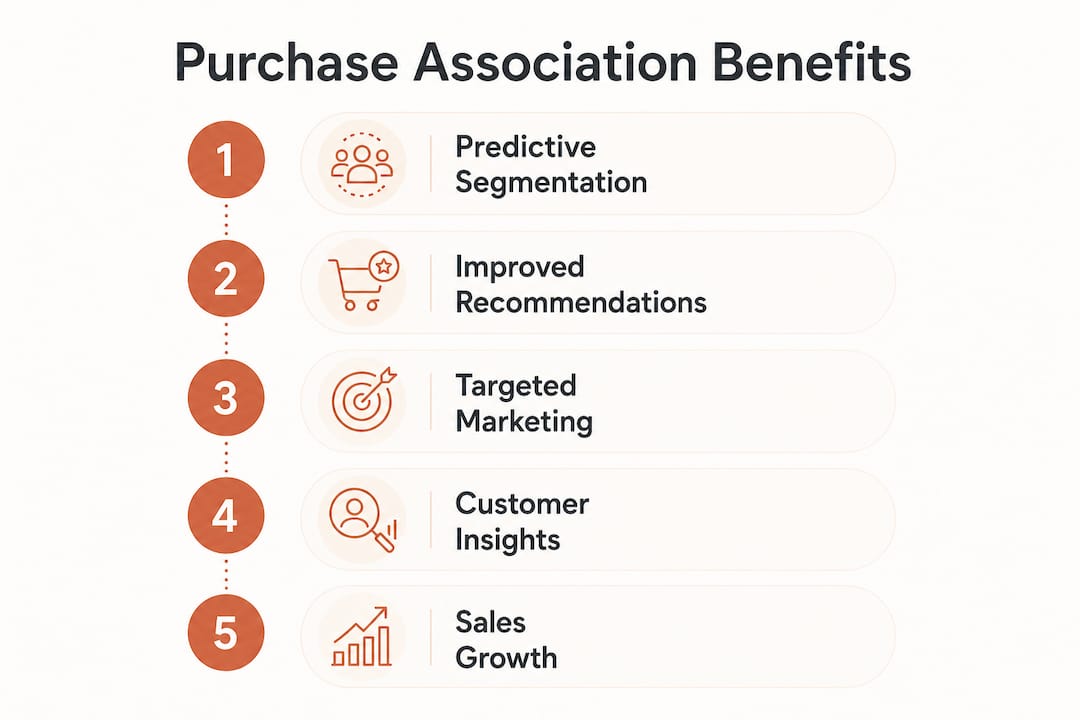
The practical benefits break down into four areas:
- Cross-selling and upselling. When a customer adds a camera to their cart, association data tells you whether a memory card, a camera bag, or a lens filter is the statistically most likely next purchase. That specificity converts better than generic “you might also like” carousels.
- Personalized promotions. Purchase associations let you build promotions around actual buying behavior rather than category assumptions. A customer who buys protein powder and resistance bands gets a different offer than one who buys protein powder and meal prep containers.
- Product bundling. Confirmed associations give merchandising teams the evidence to create bundles that customers already want. The bundle feels natural because it reflects real purchase behavior, not a marketing team’s intuition.
- Customer segmentation. Grouping customers by their association patterns reveals behavioral segments that demographic data misses entirely. Two customers with identical demographics can have completely different purchase association profiles, which means they need different retention strategies.
Customer segmentation built on purchase associations is more predictive than RFM alone because it captures what customers buy together, not just how often or how recently they buy.
Pro Tip: Run purchase association analysis separately for new customers versus repeat buyers. The associations differ significantly, and mixing the two groups dilutes the signal in both.
How does purchase association differ from GPOs and purchasing cooperatives?
The phrase “purchase association” sometimes gets confused with procurement terms like group purchasing organizations (GPOs) and purchasing cooperatives. These are entirely different concepts, and the distinction matters for e-commerce teams who encounter the terminology.
GPOs are service providers that pre-negotiate contracts with suppliers on behalf of member organizations. Nearly 90% of US hospitals use GPO services, and 85% of Fortune 1000 companies in buying consortiums report cost savings over 10%. GPOs exist to reduce procurement costs through collective bargaining power. They are not data analytics tools.
Purchasing cooperatives are member-owned entities governed by their members rather than outside investors. They pool purchasing volume to negotiate better prices and provide community-oriented procurement support. Like GPOs, their purpose is cost reduction in procurement, not pattern analysis in transaction data.
| Concept | Purpose | Governance | Relevant to |
|---|---|---|---|
| Purchase association | Identify product co-purchase patterns in transaction data | Data-driven analytics methodology | E-commerce and marketing teams |
| Group purchasing organization (GPO) | Negotiate supplier contracts to reduce procurement costs | External service provider | Procurement and supply chain teams |
| Purchasing cooperative | Pool member buying power for better pricing | Member-owned and governed | Procurement and community organizations |
Professional purchasing associations add a fourth category: membership organizations that support procurement professionals through networking, compliance guidance, and legislative updates. These also have no connection to the data analytics concept.
The e-commerce definition of purchase association is purely analytical. It describes a pattern in customer behavior, not an organizational structure or a procurement strategy.
How to integrate purchase associations into your marketing strategy
Turning association data into revenue requires more than running an algorithm. The process has four stages, and skipping any one of them produces unreliable results.
- Collect and clean transaction data. Export complete order histories from your platform, whether that is Shopify, WooCommerce, BigCommerce, or Stripe. Remove returns, canceled orders, and test transactions. Incomplete or dirty data produces misleading associations. The quality of your output is a direct function of your input data quality.
- Choose the right analysis tool. Entry-level teams can start with CSV-based analysis platforms that require no coding. Teams with developer resources benefit from API-connected platforms that update associations automatically as new orders come in. Affinsy supports both approaches, connecting via API, CSV upload, or MCP, so teams at any technical level can run market basket analysis on their existing transaction data.
- Translate rules into campaigns. A confirmed association between product A and product B becomes a triggered email when a customer buys A but not B. It becomes a bundle offer on the product page. It becomes a retargeting ad segment. The association rule is the insight; the campaign is the execution.
- Monitor and refresh associations regularly. Purchase associations run with the data, meaning they shift as customer behavior changes. A seasonal product pairing that was strong in Q4 may be irrelevant by Q2. Stale associations produce bad recommendations, and bad recommendations erode customer trust faster than no recommendations at all.
A common pitfall is overgeneralizing rules across your entire catalog. Validating association rules within specific product categories improves accuracy and prevents the algorithm from surfacing nonsense pairings caused by unrelated products that happen to sell at the same volume.
Pro Tip: Set a calendar reminder to re-run your association analysis every 60–90 days. Consumer behavior shifts faster than most teams expect, and associations that drove strong results last quarter may already be losing their predictive power.
The evolving retail environment makes this refresh cycle even more critical. Omnichannel behavior means purchase patterns from your online store may not match patterns from your physical locations, and treating them as identical produces weaker associations in both channels.
Key Takeaways
Purchase association is the data-confirmed identification of products customers buy together, and acting on those patterns through cross-selling, bundling, and segmentation is the most direct path to higher average order value.
| Point | Details |
|---|---|
| Core definition | Purchase association identifies product co-purchase patterns from historical transaction data. |
| Key metrics | Support, confidence, and lift score the strength and reliability of every association rule. |
| Revenue impact | Retail analytics built on purchase patterns can boost average order value by over 50%. |
| Not a procurement term | Purchase association is an analytics concept, distinct from GPOs and purchasing cooperatives. |
| Refresh cycle | Re-run association analysis every 60–90 days to keep recommendations accurate as behavior shifts. |
Why I think most e-commerce teams underuse this data
After working with e-commerce analytics across retail categories, the pattern I see most often is not that teams lack purchase association data. It is that they collect it once, act on it for a quarter, and then let it go stale while continuing to run the same product recommendations indefinitely.
The teams that get the most out of purchase associations treat them as a living signal, not a one-time report. They connect their analysis to their email automation, their on-site recommendation engine, and their paid retargeting audiences simultaneously. When one association weakens, they catch it early because they are watching the lift scores, not just the revenue numbers.
The other mistake I see is treating purchase association as a standalone tactic rather than integrating it with customer segmentation. A high-lift association between two products tells you what to recommend. Combining that with RFM segmentation tells you who to recommend it to and when they are most likely to convert. That combination is where the real revenue gains live.
The teams pulling ahead in 2026 are not the ones with the most sophisticated algorithms. They are the ones who built a feedback loop between their association data, their segmentation model, and their campaign execution. The technology to do this is accessible to any mid-size e-commerce brand. The gap is almost always organizational, not technical.
— Mateusz
How Affinsy helps you act on purchase association insights
Affinsy analyzes your historical transaction data to surface the product associations your team can actually use. Upload a CSV from Shopify, WooCommerce, BigCommerce, or Stripe, or connect via API, and the platform runs market basket analysis to score every product pairing by support, confidence, and lift. The free tier covers up to 20,000 line items with no credit card required, so you can validate the approach before committing to a paid plan. Pro starts at $49/month and Max at $199/month for larger datasets and full API access. Enterprise pricing is available on request.
FAQ
What is purchase association in simple terms?
Purchase association is the pattern of products that customers frequently buy together, identified through data analysis of order history. It tells you which product combinations are statistically meaningful, not just coincidental.
How do purchase associations improve product recommendations?
Association rules scored by lift and confidence identify which products genuinely predict each other’s purchase. Recommendation engines built on these rules convert better than those based on category logic or editorial curation.
What is the difference between purchase association and a GPO?
A purchase association is a data analytics concept describing product co-purchase patterns in transaction data. A group purchasing organization (GPO) is a procurement service that negotiates supplier contracts to reduce costs for member organizations. The two terms have no functional overlap.
How often should purchase associations be updated?
Association analysis should be refreshed every 60–90 days. Customer behavior shifts with seasons, promotions, and catalog changes, and stale association data produces inaccurate recommendations that reduce conversion rates.
What data do you need to run purchase association analysis?
You need complete order transaction records that include order IDs and the specific products purchased in each order. Clean data with returns and test orders removed produces the most reliable association rules.