
TL;DR:
- Cohort analysis groups customers by shared characteristics to reveal retention and revenue patterns over time.
- It helps identify onboarding issues, validate marketing efforts, and inform product bundling strategies.
- Regular, thoughtful cohort analysis enables data-driven decisions to improve retention and increase average order value.
Most e-commerce teams drown in data but still can’t explain why last quarter’s customers stuck around while this quarter’s vanished after one purchase. The instinct is to pull more reports, add more dashboards, and layer on more metrics. But raw volume rarely brings clarity. Cohort analysis cuts through the noise by grouping customers based on a shared starting point and tracking how their behavior evolves over time. This article breaks down what cohort analysis actually is, how it surfaces patterns that aggregated reports bury, and how you can use those patterns to build smarter product bundles and retain more customers.
Table of Contents
- What are customer cohorts and why do they matter?
- How cohort analysis reveals actionable customer behavior
- Comparing cohort analysis to other segmentation methods
- Applying cohort insights: Driving product bundling and higher AOV
- Why most customer cohort analysis falls short—and how to do it right
- Unlock powerful cohort analytics for your e-commerce brand
- Frequently asked questions
Key Takeaways
| Point | Details |
|---|---|
| Cohorts reveal customer journeys | Analyzing cohorts lets you track how different customer groups behave and uncover trends missed by averages. |
| Retention and revenue signals | Cohort analysis highlights drops or gains in retention and spending, making it easy to spot both issues and successful initiatives. |
| Actionable bundling insights | Deploy cohort findings to build smarter bundles and product offers that lift average order value and loyalty. |
| Continuous improvement | Regularly updating cohort analysis ensures you quickly adapt to market shifts and optimize your growth strategies. |
What are customer cohorts and why do they matter?
A cohort is simply a group of customers who share a common characteristic, most often the date of their first purchase. Instead of looking at all your customers as one blended mass, cohort analysis separates them into distinct groups and tracks each group’s behavior independently over time. As cohort analysis for businesses explains, this method groups customers sharing a common trait, typically first purchase date, and tracks behavior like retention and revenue over time using transaction data.
Why does this matter? Because averages lie. If your overall retention rate holds steady at 35%, that number feels reassuring. But underneath it, your January cohort might be retaining at 50% while your March cohort crashes to 18%. Without separating those groups, you’d never see the problem forming in real time.
Here’s what cohort analysis lets you do that traditional aggregate reporting simply cannot:
- Track retention curves for each group of customers from the moment they first buy
- Measure revenue contribution over months or years, not just at the point of acquisition
- Spot onboarding failures when a specific cohort drops off sharply after the first or second purchase
- Validate marketing experiments by comparing cohorts acquired through different channels or campaigns
- Identify loyalty surges in cohorts that received specific post-purchase experiences
Consider a practical example. You run a monthly email campaign and acquire a batch of new customers every month. By treating each monthly batch as its own cohort, you can ask: “Are the customers we acquired in February still buying in May?” If February’s cohort is thriving and April’s cohort already looks flat, you have a concrete signal that something changed, whether that’s ad creative, product quality, or the post-purchase experience.
“The real power of cohort analysis isn’t just seeing what happened. It’s understanding when it happened and to whom, so you can actually do something about it.”
This is also where customer segmentation explained becomes relevant. Cohort analysis is one of the most dynamic forms of segmentation because it tracks customers as they move through their lifecycle, not just as a static snapshot of who they are today. It answers the question every growth team should be obsessed with: are the customers we’re bringing in getting better or worse over time?
How cohort analysis reveals actionable customer behavior
Once you have cohorts defined, the real work begins: reading the patterns they reveal and translating those patterns into decisions. The most important metrics to track within each cohort are retention rate, revenue per cohort, and repeat purchase rate. Each one tells a different story.
Here’s a systematic way to approach cohort behavior analysis:
- Build your retention table. Plot each cohort along the vertical axis and time periods (weeks or months) along the horizontal axis. Each cell shows the percentage of that cohort still active in that period.
- Look for diagonal patterns. If multiple cohorts show a steep drop between period one and period two, that’s a systemic onboarding issue, not a one-off anomaly.
- Identify outlier cohorts. A cohort that retains significantly better than others is a goldmine. Find out what was different about that acquisition period or post-purchase experience.
- Overlay revenue data. Retention alone doesn’t tell you profitability. A cohort that retains at 40% but spends 3x more per order is far more valuable than one retaining at 60% with minimal repeat spend.
- Compare cohorts across channels. If paid social cohorts churn faster than organic search cohorts, your acquisition mix may be pulling in lower-quality customers at a high cost.
As cohort analysis for businesses notes, declining cohort curves signal acquisition quality drop, while improving curves validate retention efforts. This is critical because it means cohort data isn’t just diagnostic, it’s evaluative. You can use it to confirm whether a new retention initiative is actually working before committing more budget.
Pro Tip: Don’t wait for a full year of data to act. Even 60 to 90 days of cohort behavior can reveal early warning signs. A cohort that shows unusually low second-purchase rates in the first 30 days is almost certainly going to churn at high rates by month three.
The customer retention strategies that work best are those built on behavioral evidence, not assumptions. Cohort data gives you that evidence. When you see a specific cohort underperforming, you can launch a targeted win-back campaign for exactly those customers rather than blasting your entire list with a generic discount. That precision is what separates brands that scale efficiently from those that burn budget on retention theater.

For teams already focused on optimizing retention, cohort analysis provides the feedback loop that makes every initiative measurable. And for brands building out online retailer retention strategies, cohort curves are the clearest signal of whether those strategies are moving the needle.
Comparing cohort analysis to other segmentation methods
Cohort analysis is powerful, but it’s not the only tool in your analytics kit. Understanding where it fits relative to other segmentation approaches helps you use each method at the right moment.
| Feature | Cohort analysis | RFM segmentation | Demographic segmentation |
|---|---|---|---|
| Time dimension | Yes, tracks behavior over time | Partial (recency) | No |
| Best for | Retention, LTV, lifecycle trends | Campaign targeting, win-back | Persona building, ad targeting |
| Data required | Transaction history with timestamps | Recency, frequency, monetary data | Customer profile data |
| Dynamic or static | Dynamic | Semi-dynamic | Mostly static |
| Reveals acquisition quality | Yes | No | No |
Classic demographic segmentation groups customers by age, location, or income. It’s useful for building personas and targeting ad campaigns. But it tells you nothing about how those customers behave after they buy, or whether they come back at all.
RFM segmentation (Recency, Frequency, Monetary) is a step closer to behavioral analysis. It scores customers based on how recently they purchased, how often they buy, and how much they spend. It’s excellent for identifying your best customers right now and flagging those at risk of churning. But it’s still a snapshot. It doesn’t show you how behavior evolved from the moment of first purchase.
Cohort analysis fills that gap. As cohort analysis for businesses confirms, tracking behavior like retention and revenue over time using transaction data is what makes cohorts uniquely powerful for understanding customer journeys.
Here’s when to use each approach:
- Cohort analysis: When you want to understand lifetime value trends, evaluate acquisition quality, or measure the impact of a product or experience change over time
- RFM segmentation: When you need to quickly identify who to target for a campaign or which customers are about to lapse
- Demographic segmentation: When you’re building top-of-funnel audiences or crafting brand messaging for a specific persona
The smartest e-commerce teams use all three in combination. Cohort analysis tells you the story of customer journeys. RFM tells you who needs attention right now. Demographics tell you who to go find next. Leaning on segmentation methods that work together gives you a complete picture rather than a fragmented one.
Applying cohort insights: Driving product bundling and higher AOV
Here’s where cohort analysis gets exciting for revenue teams. Once you know how different customer groups behave over time, you can start using that knowledge to influence what they buy and how much they spend per order.
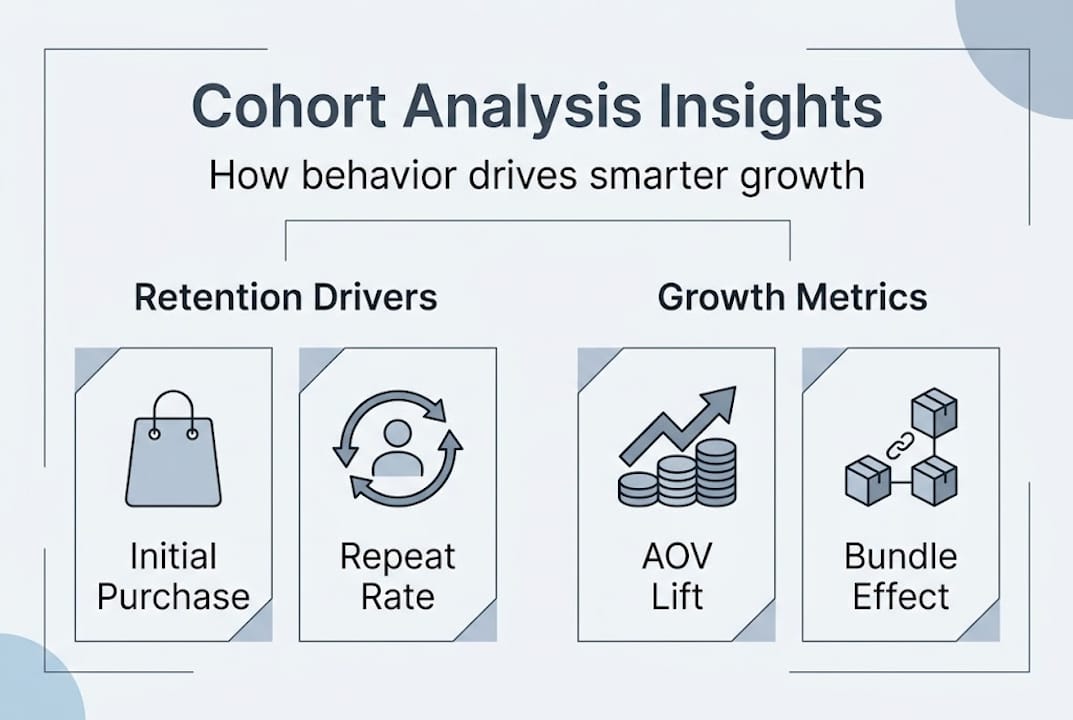
The connection between cohort data and product bundling works like this: customers who joined in the same period often share similar purchase sequences. They may have discovered your brand through the same channel, been attracted by the same hero product, or responded to the same seasonal promotion. That shared context means their buying patterns tend to cluster in predictable ways.
| Cohort | First purchase | Most common second purchase | Average time to second purchase | AOV lift with bundle |
|---|---|---|---|---|
| January (winter promo) | Product A | Product C + Product D | 18 days | +34% |
| March (spring launch) | Product B | Product E | 22 days | +28% |
| June (summer sale) | Product A | Product F + Product C | 14 days | +41% |
By analyzing purchase sequences within each cohort, you can identify which products are most commonly bought together and in what order. That’s your bundle blueprint.
Here’s how to turn cohort purchase data into bundling strategy:
- Map the first-to-second purchase path for your top three cohorts. What product did they buy first, and what did they buy next?
- Look for frequently bought together patterns within cohorts, not just across your entire catalog. Cohort-specific bundles often outperform generic ones because they’re grounded in real behavioral evidence.
- Time your bundle offers based on the average days-to-second-purchase for each cohort. If a cohort typically returns in 18 days, a bundle offer on day 15 lands at exactly the right moment.
- Test personalized recommendations for each cohort segment rather than showing the same “you might also like” to every customer.
Pro Tip: Cohorts acquired during seasonal promotions often have very different second-purchase behavior than cohorts acquired through evergreen channels. Build separate bundle strategies for each rather than assuming one approach fits all.
Brands that apply this level of cohort-informed targeting consistently report meaningful lifts in average order value. The data behind boosting bundling AOV shows that behavioral targeting, grounded in real transaction data, outperforms generic bundling by a significant margin. The reason is simple: you’re not guessing what customers want. You’re reading what similar customers already did.
Why most customer cohort analysis falls short—and how to do it right
Here’s the uncomfortable truth most analytics content won’t say out loud: most teams that attempt cohort analysis do it wrong, not because the method is hard, but because they pick the wrong cohort criteria or stop at surface-level metrics.
The most common mistake is using the wrong grouping variable. Grouping by first purchase date is a solid default, but it’s not always the most revealing choice. Sometimes grouping by acquisition channel, first product category, or promotional event gives you far sharper insights. If you only ever group by date, you may miss that your paid social customers churn at twice the rate of your organic customers, regardless of when they joined.
The second mistake is tracking vanity metrics. Retention rate looks great in a board deck. But if you’re not also tracking revenue per cohort, repeat purchase frequency, and product category shifts over time, you’re missing the granular behavior analysis tips that actually drive decisions.
The third mistake is treating cohort analysis as a one-time report. Customer behavior shifts constantly. A cohort that looked healthy at 90 days may show signs of lapsing at 180 days. You need to revisit your cohort tables regularly, especially after major campaigns, product launches, or pricing changes. Cohort analysis is a living process, not a quarterly checkbox.
The brands that get real value from cohort analysis treat it as an ongoing conversation with their data. They iterate, they ask new questions, and they let the patterns guide their next move rather than confirming what they already believe.
Unlock powerful cohort analytics for your e-commerce brand
Understanding cohort behavior is one thing. Having the right tools to automate that analysis across thousands of transactions is what separates teams that act on insights from those who stay stuck in spreadsheets.
Affinsy was built specifically for e-commerce brands that want to move fast without needing a data science team. Upload your order data via CSV or connect through the API, and Affinsy surfaces market basket analysis patterns and customer segmentation insights that would take weeks to build manually. The free tier covers up to 20K line items with full platform access and no credit card required. For larger datasets and API access, Pro starts at $49/month and Max at $199/month. If you’re ready to turn your transaction data into a growth engine, Affinsy is where to start.
Frequently asked questions
What exactly is a customer cohort in e-commerce analytics?
A customer cohort is a group of customers who share a specific trait, usually their first purchase date, whose behavior is tracked over time. As cohort analysis for businesses explains, this method tracks behavior like retention and revenue using transaction data.
How is cohort analysis different from customer segmentation?
Cohort analysis groups customers based on a shared event in time and tracks performance longitudinally, while segmentation sorts based on static attributes like demographics or recent activity. Cohort analysis for businesses confirms that the time-based tracking is what makes cohorts uniquely actionable for lifecycle insights.
What are early signs of a retention problem visible in cohort analysis?
Sharp declines in retention or revenue for new cohorts indicate potential issues in customer experience or acquisition quality. According to cohort analysis for businesses, declining cohort curves signal acquisition quality drop and should trigger immediate investigation.
How often should brands update or revisit customer cohort analysis?
Brands should revisit cohort analysis regularly, especially after campaigns or product changes, to capture dynamic shifts in behavior. Monthly reviews are a strong baseline, with additional analysis triggered by any significant business event.
How can cohort analysis improve product bundling strategy?
By analyzing purchase patterns within cohorts, brands can spot commonly bought-together items and time bundle offers to match the average days-to-second-purchase for each group. Cohort analysis for businesses confirms that tracking purchase behavior over time using transaction data is what makes this level of personalization possible.
Recommended
- Data-Driven Ecommerce Strategies for Smarter Growth - Affinsy Blog | Affinsy
- Drive Growth with Data-Driven Decision Making - Affinsy Blog | Affinsy
- Data-driven marketing strategies for e-commerce growth - Affinsy Blog | Affinsy
- Data-Driven Decision Making in Retail – Impact on Sales Growth - Affinsy Blog | Affinsy