
TL;DR:
- Customer retention strategies involve using metrics and personalized communication to prevent customer churn and increase lifetime value.
- They are a continuous process that relies on data-driven insights and proactive engagement, not isolated campaigns.
Customer retention strategies are structured plans that keep existing customers buying, reduce churn, and grow lifetime value through targeted engagement. Defining customer retention strategies correctly means going beyond discounts and email blasts. It means building a system of metrics, personalized communication, and behavioral insight that makes customers choose you again and again. For e-commerce and retail professionals, mastering these strategies is the difference between a business that grows and one that constantly refills a leaking bucket.
What does defining customer retention strategies actually mean?
Customer retention strategies are the deliberate actions a business takes to prevent customers from leaving and to increase the frequency and value of their purchases. The industry term for the broader discipline is customer lifecycle management, but retention strategy is the operational layer where most of the measurable work happens. A well-defined retention strategy covers three things: how you measure loyalty, how you identify customers at risk of leaving, and how you act on that information before it is too late.
Retention is not a single campaign. It is a continuous process built on consistent service, relevant communication, and data you can trust. Retention results from cumulative service and proactive analytics, not from isolated “great moments.” That distinction matters because it shifts your focus from one-off promotions to repeatable systems.
The business case is straightforward. Acquiring a new customer costs significantly more than keeping an existing one. Retained customers spend more per order over time, refer others, and are less price-sensitive. Defining your retention strategy with precision is the foundation for every loyalty program, re-engagement campaign, and customer success initiative you run.
Which core metrics define customer retention and how are they calculated?
Retention metrics give you a shared language across marketing, product, and leadership. Without them, every team measures success differently and no one agrees on the problem.
The four metrics every retailer needs
The Customer Retention Rate formula is: CRR = [(E - N) / S] x 100, where E is the number of customers at the end of a period, N is new customers acquired during that period, and S is customers at the start. This formula strips out acquisition noise so you see only how well you kept the customers you already had.
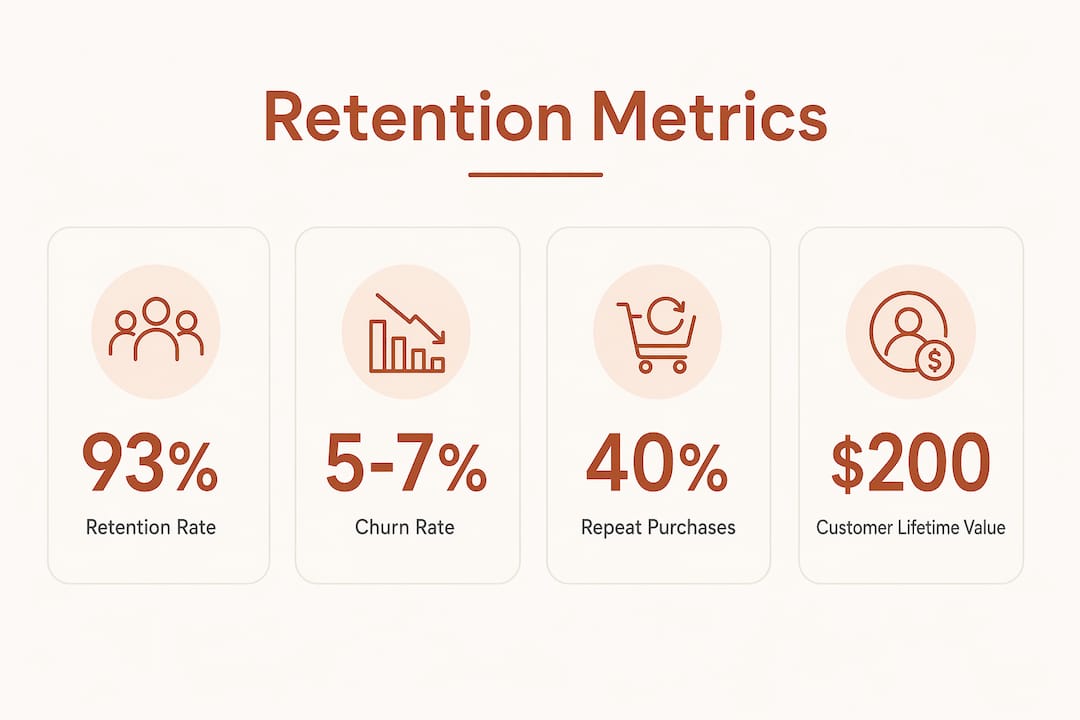
Industry benchmarks target churn between 5–7%, which translates to roughly 93% retention. That benchmark is your baseline. If your retention rate sits below 90%, you have a structural problem, not a campaign problem.
| Metric | What it measures | Why it matters |
|---|---|---|
| Customer Retention Rate (CRR) | % of customers kept over a period | Core health indicator for the business |
| Churn Rate | % of customers lost over a period | Early warning signal for service or product issues |
| Repeat Purchase Rate | % of customers who buy more than once | Measures loyalty depth in retail and e-commerce |
| Customer Lifetime Value (CLV) | Total revenue expected from one customer | Guides acquisition spend and retention investment |
Churn rate functions as a fire alarm for customer loss, but it does not tell you why customers leave. Deeper metrics like feature adoption rates and cohort retention curves pinpoint the source of the problem. That is why churn alone is never enough.
Pro Tip: Run cohort analysis monthly. Group customers by their first purchase month and track their retention curves separately. A single aggregate retention rate hides the fact that customers acquired in december may retain at half the rate of those acquired in june.
Repeat purchase rate and CLV work together. A high repeat purchase rate with a low CLV signals that customers buy often but spend little per order. A low repeat purchase rate with a high CLV signals high-value customers who are at risk of leaving after one big purchase. Both patterns require different retention responses.
What are proven strategies to improve customer retention in retail?
The most effective retention tactics in 2026 combine human trust-building with data-driven personalization. Top retention strategies include Voice of Customer programs, AI-driven churn prediction, omnichannel personalization based on behavior, behavior-triggered messaging, and loyalty rewards. Each of these works best when it is connected to a specific metric rather than deployed as a standalone tactic.

Voice of Customer programs
Voice of Customer (VoC) programs collect direct feedback through post-purchase surveys, NPS scores, and support ticket analysis. The goal is to surface the reasons customers leave before they actually do. A retailer running monthly NPS surveys can identify a drop in satisfaction scores among customers who purchased a specific product category, then act on that signal before churn spikes.
Loyalty rewards and referral programs
Loyalty programs work when they reward behavior that matters to the business, not just spending. Points-for-purchase programs are the most common format, but tiered programs that unlock perks at higher spend levels drive stronger repeat purchase rates. Referral programs add a compounding effect: retained customers bring in new customers who already have a positive first impression of the brand.
Pro Tip: Segment your loyalty program by RFM score (Recency, Frequency, Monetary value). Customers in your top RFM tier deserve different rewards than lapsed buyers you are trying to reactivate. Treating both groups the same wastes budget and dilutes the program’s perceived value.
Omnichannel communication tailored to behavior
Customers who receive generic broadcast emails disengage faster than those who receive messages tied to their actual behavior. Behavior-triggered communication, such as a cart abandonment email sent within one hour or a replenishment reminder timed to a product’s average consumption cycle, outperforms scheduled campaigns. The channel matters too. Some customers respond to SMS, others to email, and others to push notifications. Matching the message to the channel preference is a core customer loyalty technique that separates average retention programs from high-performing ones.
How can AI and analytics predict churn and personalize retention?
AI changes retention from reactive to proactive. Instead of noticing that a customer has not purchased in 90 days, a predictive model flags that customer at day 30 based on behavioral signals like declining email open rates, reduced site visits, or a support ticket that went unresolved.
- Build a behavioral baseline. Track each customer’s normal purchase frequency, average order value, and engagement patterns. Deviations from that baseline are the early signals of churn risk.
- Score customers by risk. Assign a churn probability score to each customer segment. Focus retention spend on the high-value, high-risk segment first.
- Trigger personalized outreach. When a customer crosses a risk threshold, trigger a specific intervention: a personalized discount, a check-in from customer support, or a product recommendation based on past purchases.
- Address involuntary churn separately. Payment failures cause involuntary churn that has nothing to do with customer satisfaction. Automated payment retries and proactive billing reminders recover a meaningful share of customers who would otherwise lapse without ever intending to leave.
“Consistent service and advanced analytics that flag high-risk customers for proactive intervention are the two pillars of effective retention.” — Stripe Resources
Behavioral analytics for churn prediction gives retail teams a way to act on data that already exists in their transaction history. The insight is not in any single data point. It is in the pattern across dozens of touchpoints over time.
Pro Tip: Do not wait for a customer to go silent before reaching out. Set a behavioral trigger at 60% of their normal repurchase window. If a customer typically buys every 30 days and has not engaged by day 18, that is your window to act.
Segmented churn analysis by customer tenure, acquisition channel, or plan type reveals retention leaks that aggregate churn rates hide entirely. A brand might have a healthy overall churn rate while losing 40% of customers acquired through paid social within their first 60 days. That is a targeting and onboarding problem, not a product problem.
What practical steps should retail leaders take to implement retention strategies?
Execution is where most retention programs fail. The strategy is sound, but the data is messy, the teams are misaligned, and no one owns the metrics.
Building a retention dashboard
Start with four metrics: retention rate, churn rate, repeat purchase rate, and CLV. Core retention dashboards built on clean, consistent data outperform complex analytics stacks built on unreliable inputs. Get the four core metrics right before adding cohort curves, NPS trends, or predictive scores.
- Pull data from a single source of truth. Conflicting numbers from different platforms destroy team confidence in the metrics.
- Set a fixed reporting cadence. Weekly for churn signals, monthly for retention rate and CLV trends.
- Assign ownership. One person or team is responsible for each metric. Shared ownership means no ownership.
Aligning teams around shared retention goals
Retention success requires a shared language of metrics across marketing, product, and customer success. When marketing measures email open rates and customer success measures ticket resolution time, no one is measuring the same thing. Align every team on the four core metrics and tie their goals back to those numbers.
Implementing feedback loops
Customer feedback is a retention asset when it is collected systematically and acted on quickly. Close the loop with customers who submit negative feedback within 48 hours. That single practice converts detractors into neutral or positive customers at a rate that no discount program can match. Use customer behavior analysis to identify which product categories or customer segments generate the most negative feedback, then fix the root cause rather than the symptom.
Continuous optimization means reviewing your retention metrics monthly, testing one change at a time, and measuring the impact against a control group. Retention is not a project with an end date. It is an operating discipline.
Key Takeaways
Effective customer retention strategies combine clean metrics, behavioral analytics, and consistent personalized engagement to reduce churn and grow customer lifetime value over time.
| Point | Details |
|---|---|
| Start with four core metrics | Track retention rate, churn rate, repeat purchase rate, and CLV before adding complexity. |
| Use the CRR formula | Calculate [(E - N) / S] x 100 monthly to measure true retention, excluding acquisition noise. |
| Target 93% retention | Industry benchmarks set churn at 5–7%, equating to roughly 93% customer retention. |
| Segment your churn analysis | Break churn down by tenure, acquisition channel, and plan to find specific retention leaks. |
| Automate involuntary churn recovery | Use payment retry automation and billing reminders to recover customers lost to failed payments. |
Retention strategy is simpler than most platforms want you to think
The retention technology market is full of platforms promising AI-driven personalization at scale. I have seen e-commerce teams spend months integrating complex analytics tools while their basic retention rate calculation was wrong because two data sources disagreed on what counted as a “customer.”
My honest view: master the simple metrics first. A trusted set of four metrics produces better decisions than a dashboard of 40 metrics built on inconsistent data. The teams I have seen improve retention fastest are not the ones with the most sophisticated tools. They are the ones who know their numbers cold and act on them consistently.
AI and behavioral analytics are genuinely powerful, but they amplify whatever data quality you already have. Feed them clean, consistent transaction data and they surface real patterns. Feed them messy, duplicated records and they surface noise. The human layer matters too. Proactive customer support, fast feedback loop closure, and loyalty programs that feel personal are things no algorithm replaces entirely.
The best retention programs I have encountered combine a small set of trusted metrics, a clear ownership structure, and a culture of acting on customer signals before they become churn. Technology accelerates that. It does not replace it.
— Mateusz
How Affinsy supports your retention strategy with real transaction data
Retention strategy only works when it is grounded in accurate customer data. Affinsy analyzes your historical transaction data to surface the customer segmentation patterns and product associations that drive repeat purchases.
Affinsy’s RFM customer segmentation identifies your highest-value customers, your at-risk segments, and your lapsed buyers in one analysis. The market basket analysis feature reveals which products customers buy together, giving your marketing team the cross-sell triggers that improve both retention and order value. You can connect via CSV upload, API, or MCP, with no data science skills required. The permanent free tier covers up to 20,000 line items with full product access and no credit card required. Explore customer segmentation in Affinsy’s glossary to see how segmentation maps directly to your retention goals.
FAQ
What is a customer retention strategy?
A customer retention strategy is a structured plan that uses metrics, personalized communication, and behavioral data to keep existing customers buying and reduce churn. It covers measurement, risk identification, and targeted intervention across the full customer lifecycle.
What is a good customer retention rate for e-commerce?
Industry benchmarks target a churn rate of 5–7%, which equals roughly 93% customer retention. Rates below 90% typically indicate a structural issue with product, service, or customer experience.
How do you calculate customer retention rate?
The standard CRR formula is [(E - N) / S] x 100, where E is end-of-period customers, N is new customers acquired, and S is start-of-period customers. Run this calculation monthly for the most useful trend data.
What causes involuntary churn and how do you fix it?
Involuntary churn from payment failures is a major non-obvious source of customer loss. Automated payment retry logic and proactive billing reminders recover a significant share of these customers without requiring any direct outreach.
How does customer segmentation improve retention?
Segmented churn analysis by tenure, acquisition channel, or plan type reveals specific retention leaks that aggregate rates hide. Targeting interventions at the right segment reduces wasted spend and improves the precision of your retention campaigns.
Recommended
- Customer Retention Strategies Explained for E-Commerce - Affinsy Blog | Affinsy
- Why Customer Retention Matters for E-Commerce Profits - Affinsy Blog | Affinsy
- How to optimize e-commerce retention for lasting growth - Affinsy Blog | Affinsy
- Understanding Customer Retention: A 2026 Guide for E-Commerce - Affinsy Blog | Affinsy